Site 1 : Clementi market
Markets and hawker or food centres.
All areas intended for public access.
Directional signs bearing the symbol shall be displayed at all other non-accessible entrances to direct persons with disabilities to the accessible entrance.
1. Approach to building
Access has to be provided at the level of approach for persons with disabilities to alight from and board a vehicle. In this case, the only access from the road is through the car park and there are ramps to aid people with disabilities.
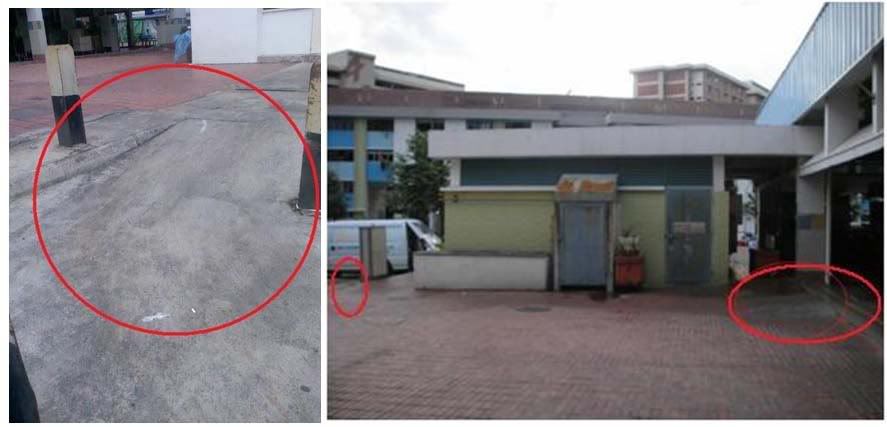
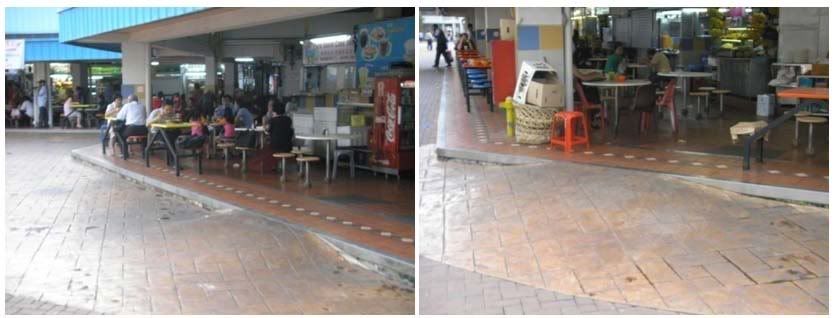
Besides access from roads, access from pathways where there is a difference in level has to be made. In this case, there is evidence of slopes to allow access from the open pathway.
These slopes have be placed from directions customers are more likely to enter the market from. For example, shaded pathways to the food market have slopes to aid the change in level.
2. CHANGE IN LEVEL
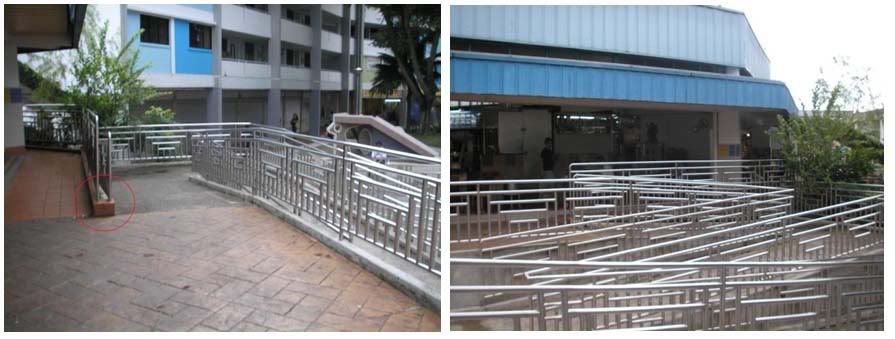
The gradient of a ramp shall be constant between landings. They can also have contrasted coloured bands to signify the ramp.
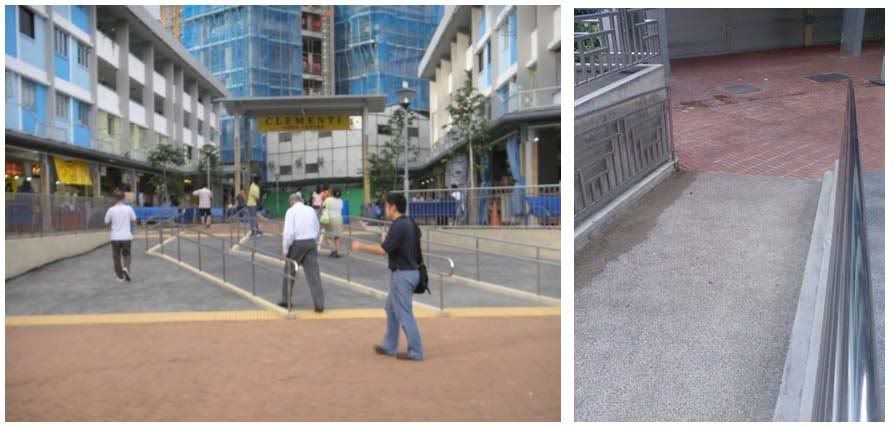
Contrasted coloured bands to signify ramp ^
Slopes have adequate width (1200 mm) and allow enough room for wheelchair users to move through. These slopes have rough surfaces which are slip-resistant and will create more friction between wheelchairs and the ground, thus causing easier movement of wheelchairs through the ramps.
The ramp leading to the residential units from the side of the market has runs which changes directions and therefore has landings between them too. Ramps also have a level landing at the top and bottom of each run and also where the run changes direction. These landings are sufficiently wide for wheelchairs and people to travel through.
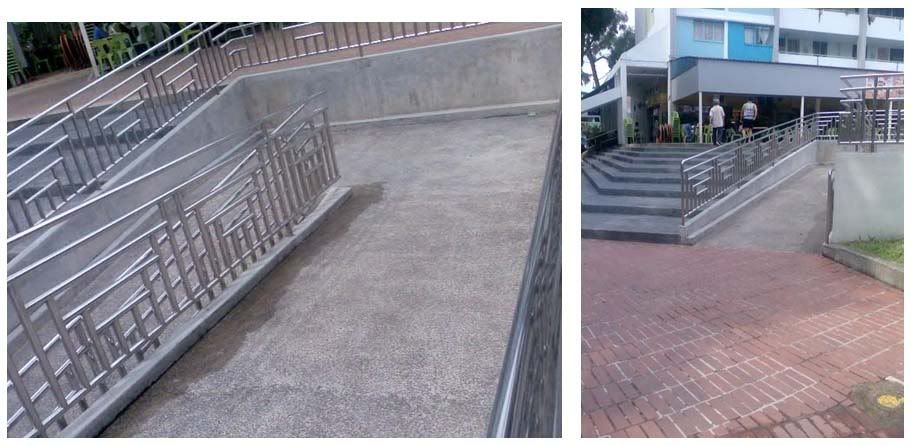
Complying with the code, as the horizontal run of an approach ramp exceeds 9.0 m in length, there is an alternative stepped approach.
A ramp run with a rise greater than 175 mm shall have handrails that are on both sides and are placed at a height of between 800 mm and 900 mm above the floor level. The ramps along the market all have handrails which comply to the code. This enables safety to those who need handrails for support.
Handrail extensions shall extend horizontally for a distance of not less than 300 mm beyond the top and bottom of the ramp to provide support for persons who may need help to negotiate the ramp; and should not project into another path of travel. (Handrails need not be provided if the gradient of a ramp is equal or gentler than 1 : 25 which is in the case of the carpark)
3. Edge Protection
Ramps and landings not adjacent to a wall shall have an edge protection such as a kerb with a minimum height of 75 mm, a raised barrier with its lower edge not more than 75 mm from the ramp or landing surface or a rail with the bottom edge not more than 75 mm from the ramp or landing surface.
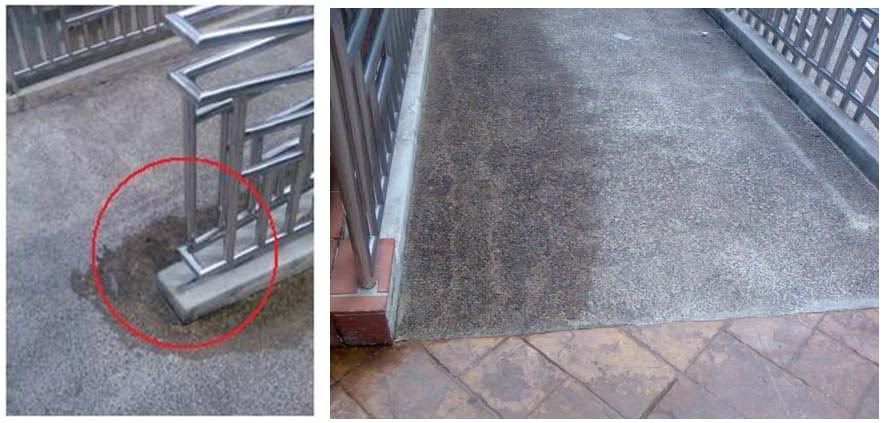
In this case, the rails are all on a kerb which complies with the rules. The ends are all safely fixed into the ground also.
4. FLOOR SURFACES
Floor surfaces are stable, firm, level and slip-resistant. Firstly, there are minimal projections, drops and unexpected variation in levels. Colours of the floor and walls are contrastingly different too. Walls are white and floor a darker shade of orange.
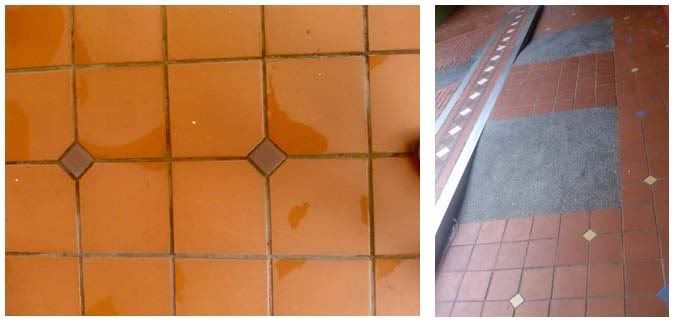
Tiles do not have cracks and are stable. Slopes have non-slip surface
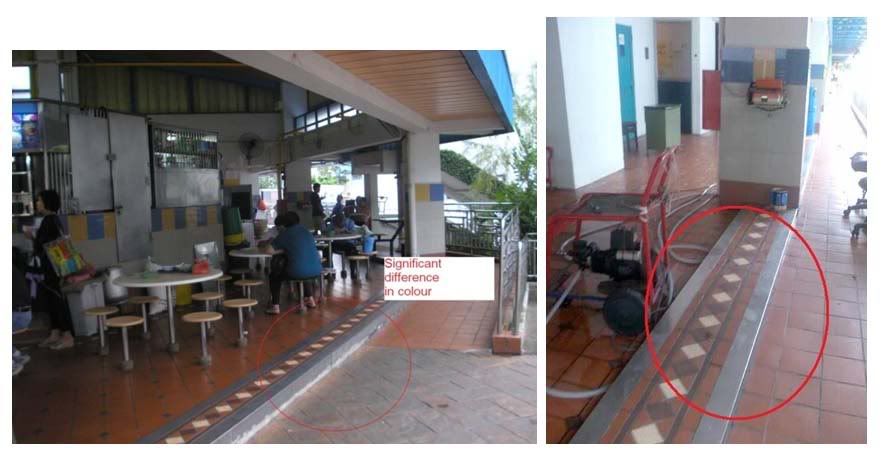
Where there is a change in level, a metallic edge protector is used to alert the users of the change in level.
5. Gratings
Where possible, gratings should be located outside the accessible route. But there are no gratings at the site.
6. Walls
The corners of walls should not have sharp edges.
The wall finish shall be smooth or, in the case of rough walls, have trailing bars placed at a height of 840 mm from the floor level so that persons with visual impairment can trail along it without hurting their hands.
In the Hawker Centre, the walls are all smooth therefore there was no need of trailing bars.
7. Protruding Objects
Obstacles, projections or other protrusions shall be avoided in pedestrian areas such as walkways, halls, corridors, passageways or aisles. Hawker centres should also avoid undetectable objects attached to a wall
Protruding trays take up space in the walkway; this could cause congestions especially during peak hours.
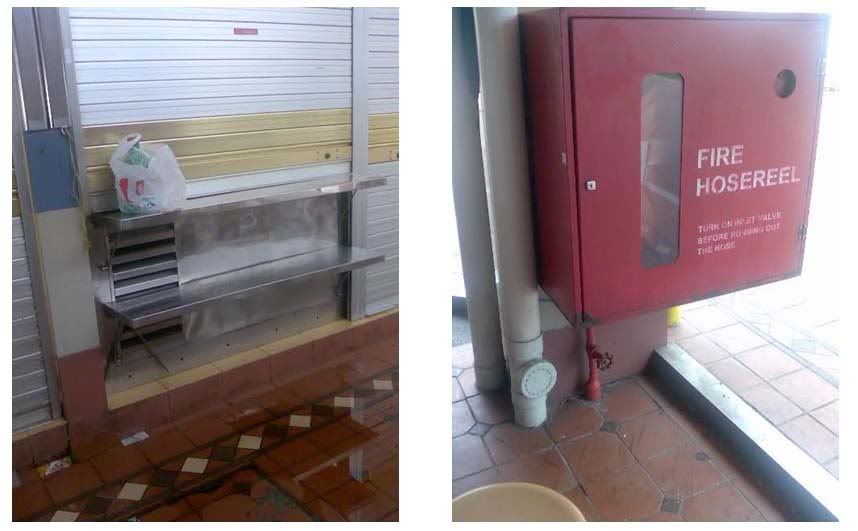
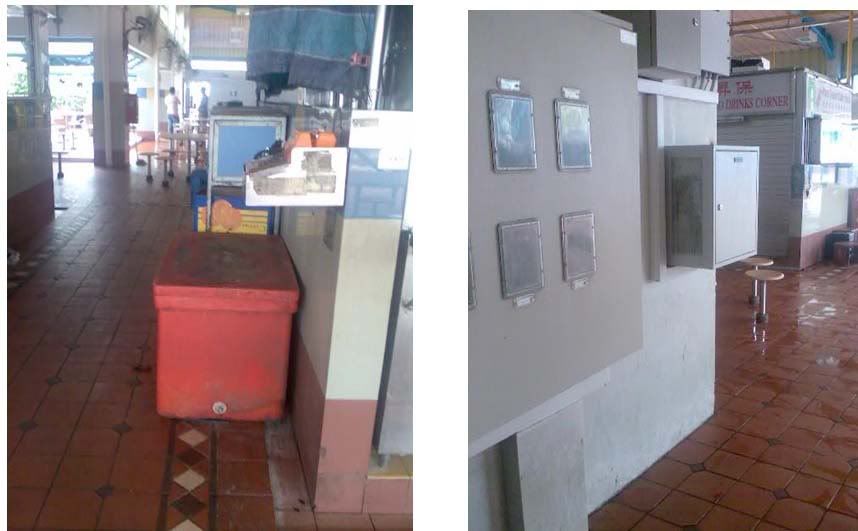
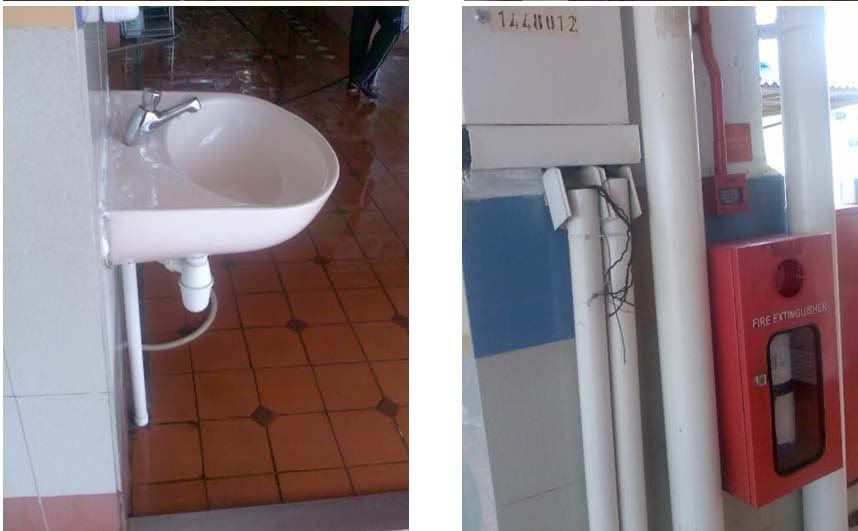
The Hawker centre consists of many common protruding objects found in any other hawker centres. It is a good safety measure to have multiple fire hose reels located as places where cooking is involved, there is a fire hazard. These items should not protrude too much such that it would cause obstruction to a wheelchair bound person who is travelling. There were many hose reels located around the centre. Its height is adequately high and low enough for a disabled person to reach and access.
Sinks are low enough to cater to wheelchair bounded persons’ access too.
In this case, there are other dangerous protruding objects where action should be taken to consideration. Loose ends of wires should not be hanging out of the walls, especially in a hawker centre where water is commonly splashed and people crowd.
8. Doors
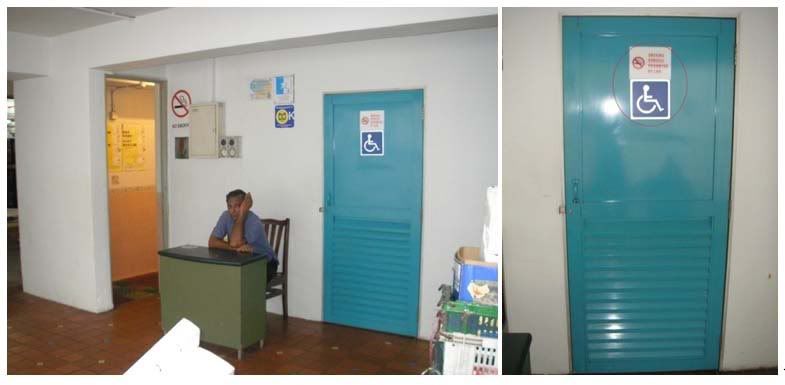
At least one power assisted or automatic door should be provided at the main entrance to a building. But for the Hawker centre, the entire area is open to enter; therefore there is no need for an entrance door. The only doors accessible to public are the toilet doors.
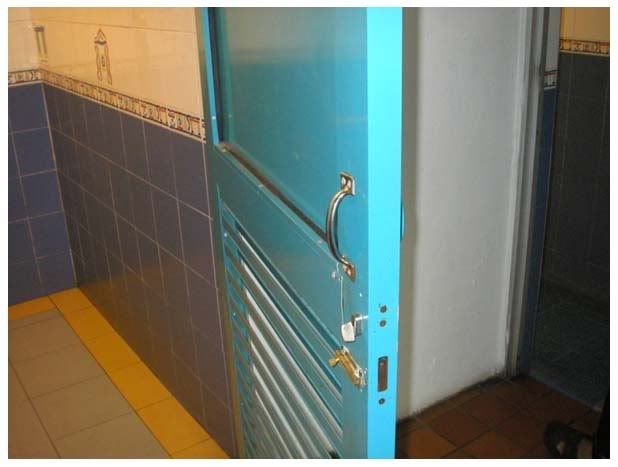
Door hardware
The door is operable by one hand, does not require fine finger control, tight grasping, pinching or twisting of the wrist to operate is be mounted at a height of 900 mm to 1100 mm from the floor.
Door handles
The door handle makes use of push-pull mechanisms that do not require grasping. They have easy to grab metal handles and is made of metal which contrasts with the colour of the door.
9. SANITARY PROVISIONS
GENERAL
At every level of a building where toilets are provided, there has to be at least one individual washroom for wheelchair users. In this case, outside the regular different gender toilets, there is an additional disabled cubicle.
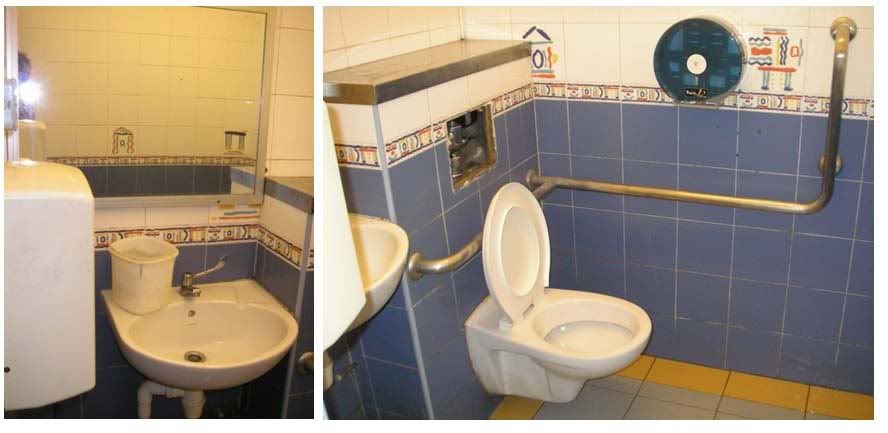
Provision for disabled toilets with adequate space and railings were made but flush is faulty and fittings not in working order.
10. ILLUMINATION
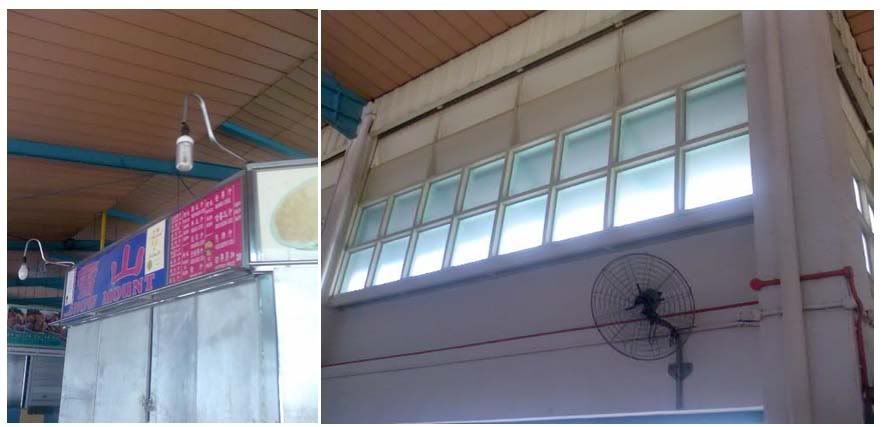
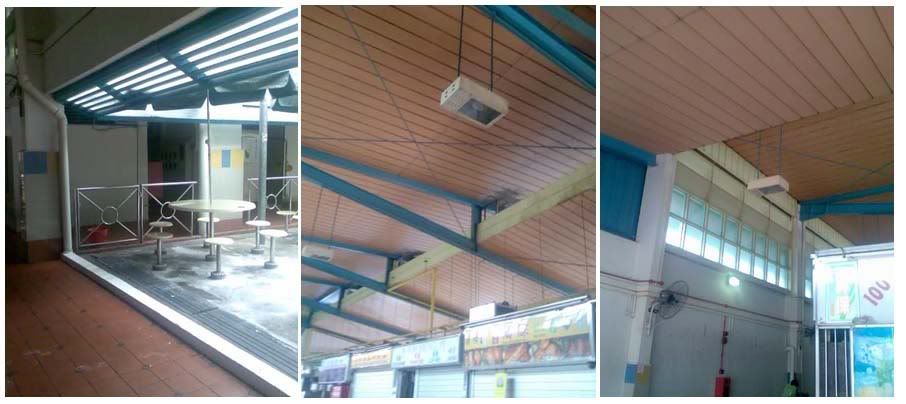
Lighting shall be uniform.
Extreme difference in the level of brightness should be avoided.
Lights shall be acceptably bright but should not cause glare or shadows that would give rise to optical illusions. Ceiling mounted light fittings with diffusers shall be positioned longitudinally at the centre of the accessible route.
EATING OUTLETS
GENERAL
Provisions of access shall be made available to persons with disabilities in accordance with clause 7.3 at all eating outlets and establishments, such as hawker centres, food courts or centres, fast food outlets and restaurants.
11. WALKWAYS WITHIN OUTLET
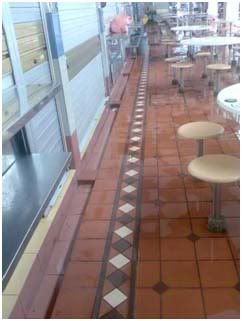
A circulation path of at least 1200 mm wide shall be provided in front of the stalls.
An accessible route with a minimum clear width of 900 mm shall be provided from the circulation path to the tables intended for persons with disabilities.
12. SEATING ARRANGEMENT
Where fixed seating is provided in eating outlets and establishments, at least one table for every 10 tables or part thereof shall be provided for use by persons with disabilities or at least two tables, whichever is the greater.
The height of the table provided for persons with disabilities shall not be higher than 800 mm with a minimum clear knee space of 680 mm high and 480 mm deep.
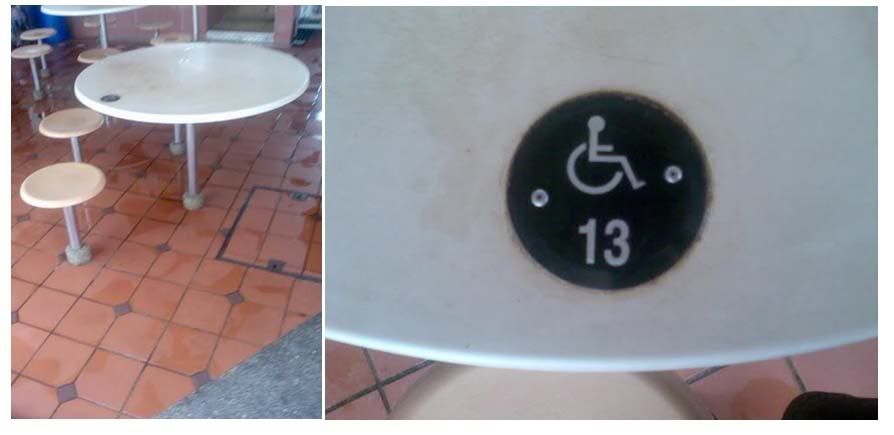
Where the eating outlet or establishment is provided with fixed seats, the minimum clear space between the seats shall be 750 mm measured along the edge of the table
There are empty spaces in between the seats to provide space for the disabled. It is recommended that about 40% of the total table capacity be provided with fixed seats. But in this case, in a usual seating, there would be about 6-7 seats, but only 2 seats were provided. More seats can be provided to have 40% of the capacity with fixed seating. These fixed seats will cater to the ambulant disabled as well as family/friends who may accompany them.
In this case, the tables for disabled are located as the first table visible from the pathways towards the hawker centre, this allows easy access to the disabled. But, besides this table, there were no other tables catered for the disabled around the hawker centre.
13. SIGNAGE
Directional signs shall be clearly displayed to direct persons with disabilities to the reserved table intended for their use.
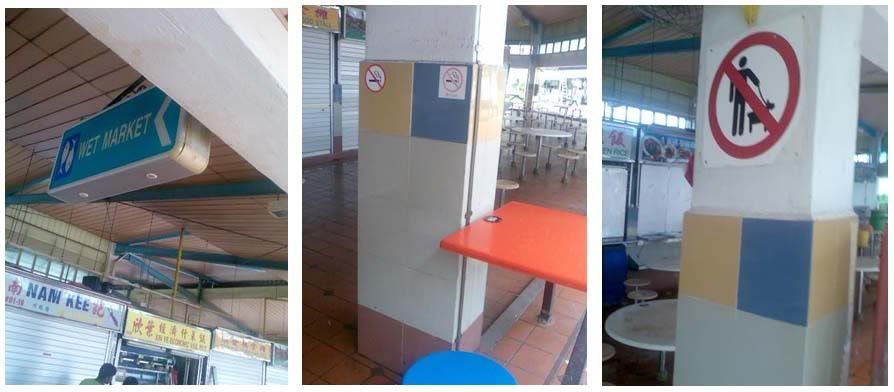
More signs leading to the washroom can be considered though as there are no signages directing to the washrooms throughout the entire hawker centre.Thus more signage can be added.
posted by Pink teddies and Turtles!! at
4:41 AM


0 Comments:
Post a Comment
Subscribe to Post Comments [Atom]
<< Home